
Fat Transfer to Breast

Overview
| Purpose | To enhance breast volume, shape and symmetry using the body’s own fat, providing a natural alternative to implants. |
| Recommended for | Individuals seeking subtle, natural-looking breast enhancement, particularly those who prefer to avoid implants and have sufficient donor fat for transfer. |
| Surgery time | Approximately 2 to 4 hours, depending on the amount of fat harvested and the extent of transfer. |
| Hospital stay | Typically performed as a day surgery. |
| Recovery | Initial recovery usually takes 1 to 2 weeks, with gradual stabilisation of breast volume over several months as the transferred fat integrates. |
Fat transfer to the breast is a natural breast augmentation technique that uses your own fat to enhance breast volume, improve shape and refine symmetry. In Singapore, this procedure is often chosen by patients who prefer subtle enhancement without implants.
Some patients may wonder whether fat can simply be “moved” from one area of the body to another. The treatment offers an approach that builds on what you already have. By using your own tissue, it allows for subtle enhancement while refining overall shape, often alongside gentle contouring of areas where excess fat is present.
The result is not just about transformation, but about balance, proportion and a result that feels like your own.

How does fat transfer to the breast work?
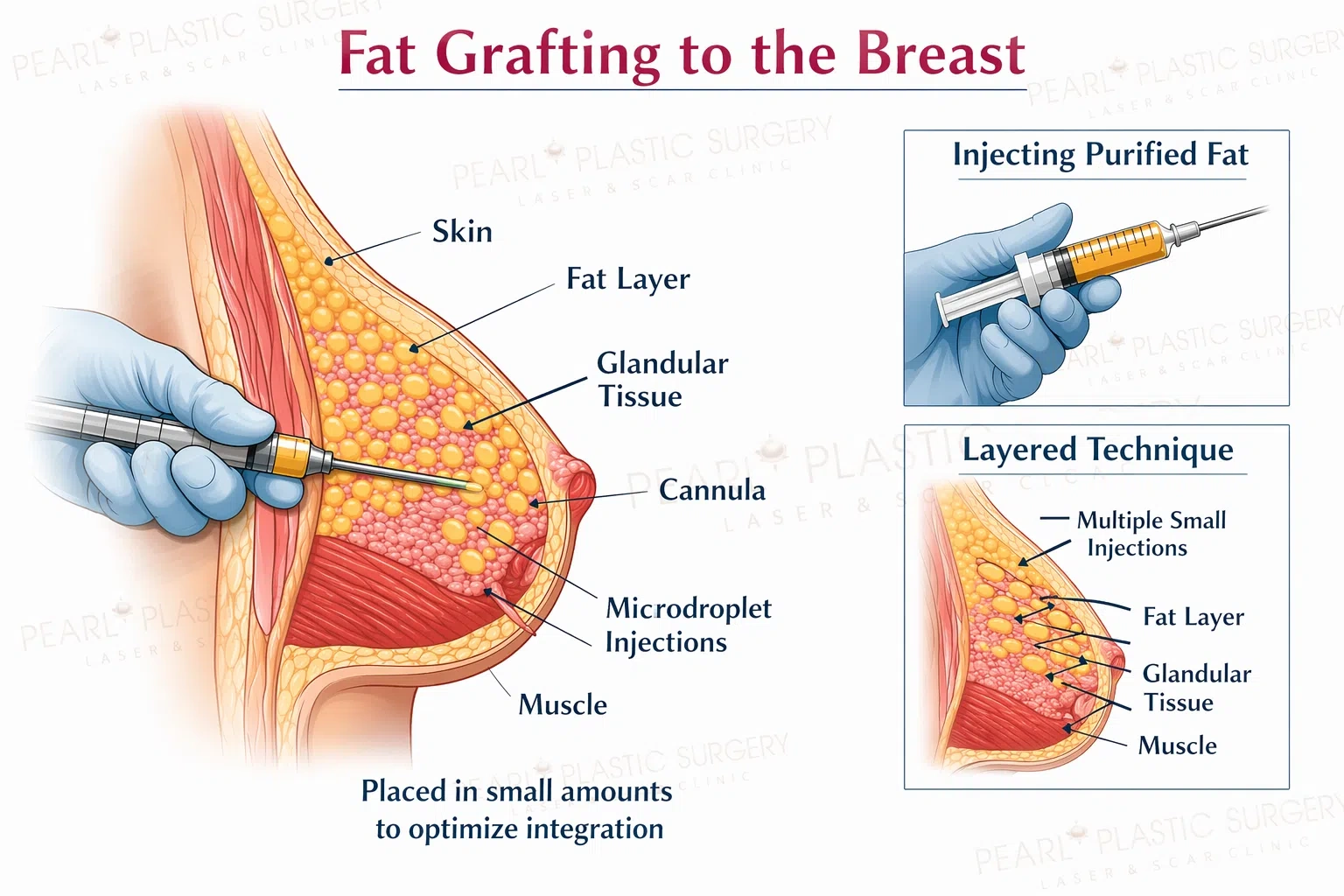
The procedure entails:
| STEPS | PROCESS |
| Fat harvesting | The procedure begins with liposuction, where fat is gently removed from donor areas such as the abdomen, thighs or flanks. The technique used is important as fat cells are extracted in a way that minimises trauma to preserve their viability. |
| Fat processing and purification | The harvested fat is then processed to separate healthy, viable fat cells from excess fluid, oil and damaged cells. This step improves the quality of the graft and supports better long-term survival. Only purified fat is selected for transfer, ensuring that what is reintroduced into the body has the highest potential to integrate successfully. |
| Strategic fat placement | The purified fat is injected into the breast in small, layered amounts using fine cannulas. This is done across multiple planes of the breast tissue rather than in a single area. This technique is essential because:
|
| Fat graft integration | After transfer, the body begins to establish a blood supply to the injected fat cells. Those that successfully integrate become a living part of the breast tissue. Some fat is naturally resorbed during the healing phase. The remaining fat stabilises over time, contributing to the final result. Because of this, treatment planning often includes a slight overcorrection to account for expected resorption. |
Dual benefit of fat transfer to breast:
Breast enhancement and body contouring
One of the distinguishing aspects of fat transfer to the breast is that it addresses two concerns within a single procedure. In addition to enhancing breast volume and shape, the treatment also involves removing excess fat from selected donor areas such as the abdomen, thighs or flanks.
This approach allows for a more balanced and proportionate outcome, as areas with unwanted fat are gently contoured while the transferred fat is used to refine the breasts. Rather than introducing foreign materials, the procedure works with your existing tissue to achieve a natural result.
Because the transferred fat comes from your own body, the risk of rejection or allergic reaction is low. The fat that successfully integrates becomes a living part of the breast tissue, while a portion may be naturally resorbed during the healing process.
Overall, the procedure offers a combined approach that enhances both breast shape and body contour, with results that develop gradually as the body heals.
Fat transfer vs Breast implants vs Breast lift: What’s the difference?
While each procedure offers enhanced cosmetic results, they serve different goals.
This includes:
| FEATURE | FAT TRANSFER | BREAST IMPLANTS | BREAST LIFT |
| Primary goal | Subtle volume enhancement | Increase breast size and fullness | Lift and reshape sagging breasts |
| Material used | Your own fat | Silicone implant | No added volume (repositions tissue) |
| Result | Soft, natural enhancement | Fuller, more defined volume | Firmer, lifted contour |
| Increase in size | Typically modest (approximately 0.5 to 1 cup) | Moderate to significant | Minimal (may appear fuller due to lift) |
| Best for | Volume + contour refinement | Noticeable enlargement | Sagging or drooping breasts |
| Feel | Natural breast tissue | Slightly firmer, depending on the implant | Natural, reshaped tissue |
| Scarring | Minimal (small incisions) | Moderate (implant placement incisions) | More visible (depends on lift technique) |
| Longevity | Long-lasting (some fat resorption) | Long-lasting, may require replacement | Long-lasting but affected by ageing |
Benefits of a fat transfer to the breast procedure
The procedure offers a unique combination of benefits, such as:
- Natural look and feel using your own tissue
- Subtle and proportionate volume enhancement
- Improved breast symmetry and contour
- Simultaneous body contouring from donor areas
- Addresses two concerns in one procedure, enhancing breast volume while contouring areas with excess fat
- No implants or foreign materials
Because fat transfer uses your own tissue, the risk of rejection or allergic reaction is low. This differs from procedures involving synthetic materials, as the transferred fat is recognised by the body and can integrate with surrounding breast tissue.
Who is a good candidate for fat transfer to the breast?
Fat transfer is most suitable for individuals who value natural enhancement and subtle refinement. You may be a suitable candidate if you:
- Prefer a more natural alternative to breast implants
- Are looking for a modest increase in breast volume rather than a significant size change
- Wish to improve breast shape, contour or symmetry
- Have experienced volume loss after pregnancy, breastfeeding or weight changes
- Have sufficient donor fat available for harvesting
- Prefer to avoid foreign materials in the body
However, suitability depends on donor fat availability, breast anatomy, skin quality and whether the desired increase in size is realistic through fat grafting alone.
As such, a consultation is highly encouraged. Our surgeon will help to determine whether your anatomy and expectations align with what fat grafting can realistically achieve.
What to expect from fat transfer to the breast procedure
The procedure does not offer an instant transformation. It is a process that unfolds gradually, with each stage contributing to the outcome.
Before the procedure
Our surgeon will assess both donor areas and breast anatomy, including skin quality, existing volume and symmetry. Planning focuses on achieving proportion while ensuring enough fat can be safely harvested.
You will also be guided on what to expect in terms of volume retention, as not all transferred fat survives.
During the procedure
The procedure combines liposuction and fat grafting in a single session. Fat is first harvested, then processed and finally reinjected into the breasts with precision.
Care is taken to distribute the fat evenly, shaping the breast while preserving a natural contour.
Immediately after the procedure
The breasts may appear fuller initially due to both swelling and the presence of transferred fat. Donor areas may feel similar to post-liposuction recovery, with mild soreness or tightness.


Recovery after fat transfer to the breast
The recovery involves attention to both the breasts and donor areas, as both contribute to the final result. Generally, you can expect:
Early recovery (First few days)
- Mild swelling and bruising are expected
- Discomfort is usually manageable with medication
- Movement may feel slightly restricted, especially in donor areas
First 1 to 2 weeks
- Swelling begins to improve
- Light daily activities can usually be resumed
- Compression garments may be recommended for donor areas
Patients are typically advised to avoid pressure on the breasts, as this supports fat survival.
Ongoing recovery
- Donor areas continue to contour and settle
- Breast volume stabilises gradually
- Subtle refinement continues over several months
Maintaining a stable weight is important, as transferred fat behaves like normal fat tissue and can change with weight fluctuations.
Book a personalised consultation
Choosing fat transfer is often about finding a balance between enhancement and authenticity. A consultation provides the opportunity to explore what is achievable based on your anatomy and goals.
Dr Pearlie will assess donor areas, breast structure and expected fat retention to guide a realistic and personalised plan. This ensures that the outcome is not only natural in appearance but also stable over time.
If you are considering breast fat transfer in Singapore, a personalised consultation can help clarify how much volume enhancement is realistically achievable and whether fat grafting is the most suitable approach for your goals.

A personalised consultation can help clarify how much volume enhancement is realistically achievable and whether fat grafting is the most suitable approach for your goals.
Frequently Asked Questions
Is fat transfer to the breast safe?
International plastic surgery guidelines recognise fat grafting as a safe procedure when performed using appropriate techniques and protocols. Because it uses your own tissue, the risk of rejection is low. Careful technique is important to support fat survival and minimise complications.
Will all the transferred fat survive?
Not all transferred fat survives and this is a normal part of the process. A portion is naturally resorbed by the body within the first few months. Your treatment plan takes this into account to achieve a balanced final result.
How much breast size increase can I expect with fat transfer?
Fat transfer is best suited for modest, natural-looking enhancement, typically around half to one cup size. The exact outcome depends on how much fat can be transferred and how well it survives.
Can fat transfer replace breast implants?
Fat transfer may be a suitable alternative for those seeking subtle, natural enhancement. However, for individuals who desire a more significant increase in size, breast implants may be more appropriate.
What is the difference between fat transfer to the breast and breast implants?
Fat transfer uses your own fat for subtle, natural enhancement, while implants are typically silicone implants for a more noticeable increase in breast size and projection. The most suitable option depends on your goals, anatomy and preference for natural tissue versus implant-based augmentation.
Will the results look and feel natural?
Yes, because the procedure uses your own fat, the results typically look and feel like natural breast tissue, without the firmness associated with implants.
Can fat transfer correct uneven breasts?
Fat transfer is often used to improve breast asymmetry, as fat can be placed more precisely to balance volume and contour between both sides.
How long do fat transfer results last?
Once the transferred fat establishes a blood supply, it becomes a lasting part of the breast. Maintaining a stable weight helps preserve results over time.
What affects the results and longevity of fat transfer to the breast?
The long-term outcome of fat transfer depends on how well the transferred fat survives and integrates with your natural breast tissue.
The factors that can influence this include:
- Fat graft survival rate – only a portion of the transferred fat establishes a blood supply and becomes permanent
- Surgical technique – careful harvesting, purification, and layered placement improve fat viability
- Blood supply in the breast tissue – healthy tissue supports better integration of fat cells
- Volume transferred – overly large transfers may reduce survival due to limited oxygen supply
- Post-procedure care – avoiding pressure on the breasts supports early healing
- Weight stability – significant weight fluctuations can affect the size of the transferred fat
Can I lose the transferred fat if I lose weight?
Yes, since the transferred fat behaves like normal fat tissue, significant weight loss may reduce breast volume. Weight stability is important for maintaining results.
Will there be scars after fat transfer?
Scarring is minimal, as only small incisions are used for liposuction and fat injection. These are typically discreet and heal well over time.
Can fat transfer to the breast increase cancer risk?
Fat transfer does not cause breast cancer. Current evidence suggests that it does not increase breast cancer risk when performed appropriately. Routine breast screening can still be carried out as normal after the procedure.
How long is the downtime after fat transfer to the breast?
Most patients can return to light activities within 1 to 2 weeks, although full recovery and final results develop over several months.
What influences the cost of fat transfer to the breast in Singapore?
The cost can vary depending on:
- The amount of fat required for transfer
- The number and location of donor areas
- The complexity of the procedure
- Facility and anaesthesia requirements
Some patients may require more than one session to achieve their desired outcome. A consultation is needed for an accurate estimate.
Is fat transfer to the breast claimable by insurance?
Fat transfer for aesthetic breast enhancement is generally not claimable.
However, in reconstructive cases, such as after breast cancer surgery, partial claims may be considered, depending on medical indication and prevailing guidelines. This can be discussed during consultation.