
Skin Cancer Removal & Reconstruction

Overview
Purpose | To completely remove cancerous skin lesions with appropriate margins and reconstruct the affected area, preserving function and appearance. |
Recommended for | Individuals diagnosed with or suspected to have skin cancer, particularly when lesions are located in visible areas such as the face, scalp, neck or hands. |
Surgery time | Approximately 1 to 3 hours, depending on the size of the lesion and complexity of reconstruction. |
Hospital stay | Typically performed as a day surgery. |
Recovery | Initial healing usually occurs within 1 to 2 weeks, with gradual scar maturation over several months. Recovery duration varies based on the extent of excision and reconstruction. |
Skin cancer is one of the most common malignancies in Singapore, and the risk of skin cancer increases with chronic UV exposure, outdoor occupations, fair skin, previous sunburn and aging. While early detection is critical, effective treatment involves more than removing the cancerous lesion alone.
Surgical precision and well-executed reconstruction play an equally important role in preserving appearance, function and long-term skin health, particularly when treatment involves the face or other visible areas.

What is skin cancer removal
and reconstruction?
Skin cancer removal and reconstruction is an integrated surgical approach that has two goals:
- complete removal of the cancer with adequate safety margins
- reconstruction of the resulting defect to restore normal appearance and function
After the cancerous tissue is excised, the remaining wound may vary in size, depth and location. Reconstruction is planned carefully to optimise healing, minimise scarring and distortion to surrounding areas especially if near critical areas like the ears, eyes, nose and lips.
In many cases, both removal and reconstruction are performed at the same time.
Why reconstruction is an important part of treatment

Removing skin cancer without considering reconstruction may result in undesirable distortion, tightness and poor scarring. Reconstruction allows the surgical site to heal without tension, and heal in a favourable way, preserving form and function.
The key benefits of a combined approach include:
- Complete cancer removal with appropriate margins
- Preservation of facial features.
- Improved cosmetic outcome compared to excision alone
- Reduced wound tension, supporting better scar healing
- A single, coordinated treatment plan rather than fragmented care
How can I tell if it’s skin cancer?
Skin changes are common and often harmless, but certain features should prompt medical assessment, especially when a lesion behaves differently from surrounding skin or continues to evolve.
Signs that may warrant further assessment include:
- A lesion that grows, changes or does not heal – skin cancers often continue to enlarge or fail to resolve over time, unlike benign wounds or spots that heal naturally.
- New or changing growths in sun-exposed areas – lesions appearing on the face, scalp, ears, neck or hands deserve particular attention due to cumulative sun exposure.
- Irregular borders or uneven colour – asymmetry, blurred edges or mixed pigmentation may reflect abnormal skin cell behaviour.
- Bleeding, crusting or ulceration without injury – spontaneous bleeding or scabbing can indicate fragile or abnormal tissue growth.
- A sore that heals and repeatedly reopens – delayed healing and/or recurrent breakdown may suggest underlying skin pathology.
- Changes in an existing mole or spot – alterations in size, shape, colour, thickness or sensation should be evaluated, even if subtle.

Is it a mole or skin cancer?
A widely used clinical tool to help identify suspicious skin lesions is the ABCDE criteria — a five-point checklist that guides both clinicians and patients in recognising the early warning signs of skin cancer. While the presence of any single feature does not confirm a diagnosis, lesions displaying one or more of these characteristics warrant prompt evaluation by your doctor.
What to look out for in skin cancers: ABCDE
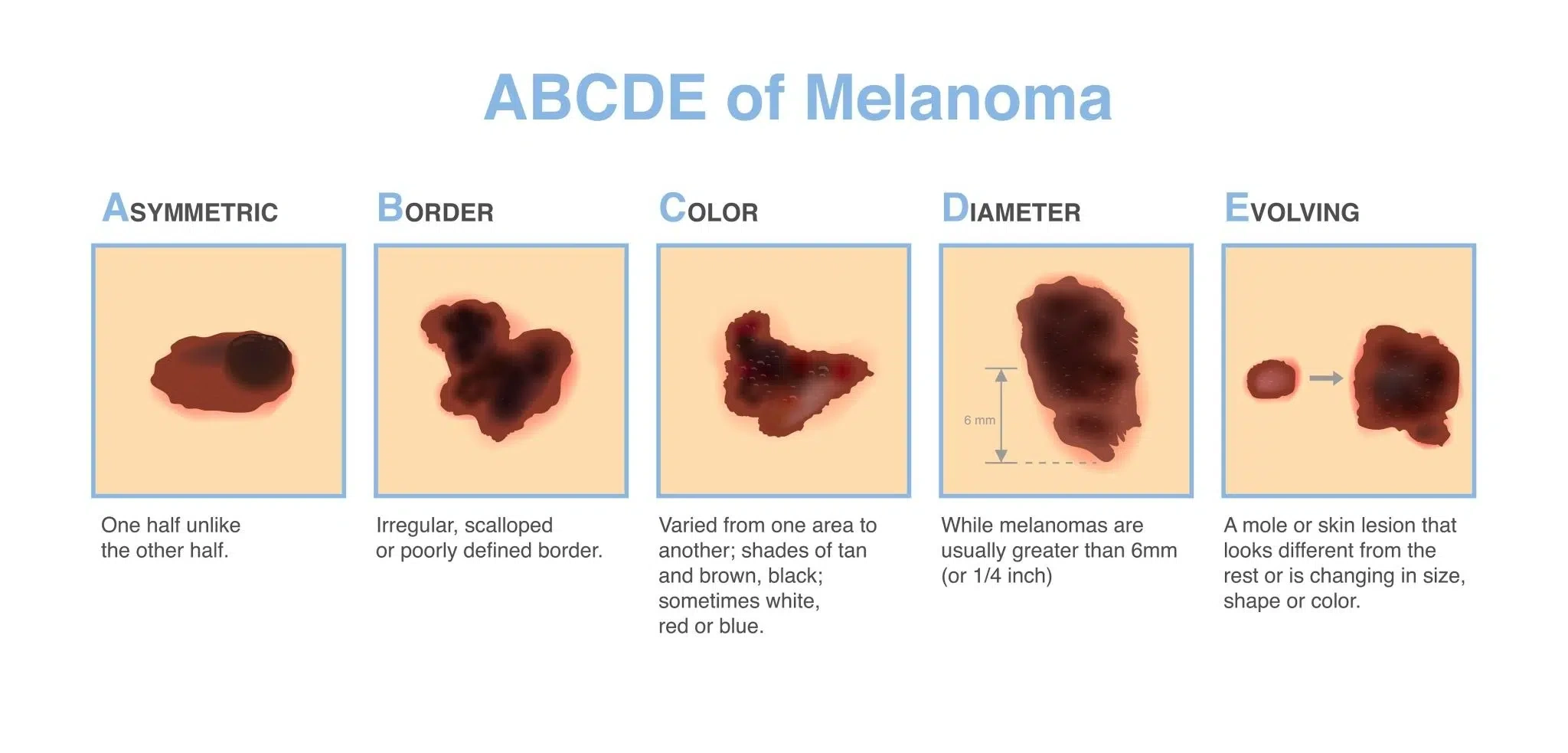
A | Asymmetry — One half of the mole does not match the other. A normal mole is typically symmetrical in shape. |
B | Border — Edges are irregular, ragged, notched or blurred. Benign moles tend to have smooth, well-defined borders. |
C | Colour — Uneven colour or multiple shades (brown, black, red, white or blue) within the same lesion. Normal moles are usually a single uniform shade. |
D | Diameter — Larger than 6mm across, roughly the size of a pencil eraser. Melanomas are often larger, though they can be smaller when first detected. |
E | Evolution — Any change in size, shape, colour, or new symptoms such as bleeding, itching or crusting. Change over time is one of the most important warning signs for skin cancer. |
Skin cancer surgery and reconstruction in Singapore. Personalised care by experienced Plastic Surgeon, Dr Pearlie Tan.
Common types of skin cancer
Skin cancer removal and reconstruction may be recommended for a range of skin cancers, such as:
- Basal Cell Carcinoma (BCC) – the most common form of skin cancer, often slow-growing and invades local structures if left for too long. Surgical removal is frequently required, especially when located on the face or nose.
- Squamous Cell Carcinoma (SCC) – a more aggressive type that may grow faster and has a higher risk of distant spread if untreated. Prompt excision with appropriate margins is typically advised.
- Melanoma – a less common but more serious form of skin cancer with high risk of metastasis. Surgical removal is essential, with reconstruction planned according to tumour depth, margins and anatomical location.
- Other atypical or rare skin tumours – certain lesions benefit from plastic surgical involvement when their size, location or behaviour requires it.


Who requires skin cancer
removal and reconstruction?
Not all skin cancers require complex reconstruction. You may need reconstruction if:
- The lesion is near the eyes, nose or mouth and direct wound closure would cause obvious distortion.
- The cancer is in a part of the face or body where the surrounding skin is very tight and closing the wound by direct closure will cause too much tension leading to poor wound healing and possibly wound break-down.
- The tumour characteristics and stage necessitates wide excision margins rendering the wound defect too large for direct simple closure.
How is skin cancer removal and reconstruction performed?
Skin cancer removal and reconstruction is a stepwise process, carefully planned to balance medical safety with aesthetic and functional outcomes.
- Pre-operative assessment and planning – the consultation includes evaluation of the lesion, surrounding skin quality, medical history and reconstruction options. Surgical margins and closure techniques are planned to ensure tension-free wound closure for the best healing possible while preserving form and function.
- Cancer removal – the lesion is excised with appropriate safety margins to reduce the risk of recurrence. The lesion will be sent for histology analysis.
- Reconstruction – Wound closure is performed using the most suitable technique, which may include direct closure, local tissue rearrangement (flap) or skin grafting. The goal is to restore contour while minimising visible scarring and functional disruption.
Reconstruction techniques after skin cancer removal

Our Plastic Surgeon, Dr Pearlie will explain the rationale for the chosen technique during consultation. Reconstruction is tailored to each individual and may involve one or more of the following approaches:
- Direct closure – ideal for small defects where the surrounding skin can be brought together without tension
- Local skin flaps – nearby skin is repositioned to cover the defect while maintaining colour and texture match
- Skin grafts – A thin layer of healthy skin is taken from one area of the body to cover larger wounds
- Free flaps/microsurgery– In complex cases, microsurgical reconstruction may be needed where a flap (unit of skin, fat with or without muscle) will be transferred from an appropriate body part (donor site) and blood flow established in the recipient site to reconstruct the wound.

Recovery and post-treatment care

Recovery varies depending on the extent of surgery and reconstruction performed. Most patients can expect:
- Mild swelling, bruising or tightness in the treated area
- Clear wound care instructions on how to look after the wound at home and when to come back for review and removal of stitches.
- Follow-up visit to monitor healing and discuss histology results
- Gradual scar maturation over several months
Sun protection and scar optimisation measures are often recommended to protect healing skin and improve long-term outcomes.
Are you ready to take the next step? Consult us now.
What are the potential risks and considerations?
Skin cancer removal and reconstruction are generally safe when performed by skilled specialists, but potential considerations include:
- Co-existing medical conditions like diabetes and vascular disease which is associated with poorer wound healing
- Smokers generally heal slower than non-smokers
- Scarring which will be managed closely by Dr Pearlie with scar gels and scar sheets and sometimes laser therapy in individuals at high risk of developing hypertrophic scars and keloids.
- Need for further treatment if margins are not clear
- Recurrence risk, depending on cancer type and behaviour
What is the cost of skin cancer removal and reconstruction in Singapore?
The cost of skin cancer removal and reconstruction in Singapore varies based on individual factors rather than a fixed fee. Some of the key considerations include:
- Size, depth and location of the lesion
- Type of reconstruction required
- Single-stage versus staged procedures
- Anaesthesia and facility fees
- Histopathology and follow-up care
At Pearl Plastic Surgery, skin cancer removal and reconstruction surgery generally starts from $2,000.
Book a comprehensive and individualised assessment
If your suspicious mole has changed, persisted or you simply want to have it checked out, come for an early assessment. At Pearl Plastic Surgery, Dr Pearlie offers personalised consultations to evaluate skin concerns and guide you through the most appropriate next steps.
Early assessment allows for more treatment options, smaller procedures and better reconstructive outcomes. Book an appointment for a detailed diagnosis and comprehensive treatment plan.

Frequently Asked Questions
Is skin cancer removal urgent?
Early assessment is important. Prompt treatment helps prevent progression and allows for simpler surgery with better reconstructive outcomes.
How soon should I book a consultation if I’m unsure?
You do not need to wait for certainty. A consultation provides assessment, reassurance and guidance on whether treatment is needed.
What if the lesion turns out to be benign?
Assessment brings clarity. If the lesion is benign, you gain peace of mind and advice on monitoring or removal if appropriate.
Will all the skin cancer be removed during surgery?
The aim is complete removal with appropriate margins. Pathology analysis confirms clearance and further treatment is discussed if needed.
Do I need a plastic surgeon for skin cancer removal?
A plastic surgeon is able to give you the best scar possible and a Plastic and Reconstructive surgeon is fully trained and equipped to manage skin cancers that require any closure method from simple direct closure to complex flap reconstruction. The aim is to preserve function and appearance as much as possible.
Is reconstruction done on the same day?
If needed and reconstruction is performed by a Plastic Surgeon, then in most cases, yes reconstruction is done on the same day. This cannot be said for Mohs surgery as wound closure is only performed after cancer clearance is confirmed which may not be on the same day.
Is reconstruction purely cosmetic?
No, any reconstructive surgery is performed for medical reasons to preserve form and function. It is required for wound closure to prevent open wound complications like infection, poor scarring and wound contractures.
Will removing skin cancer change how I look?
Some change is expected, but reconstruction is designed to minimise visible scarring and maintain natural facial balance.
Will I have a visible scar?
Some scarring is unavoidable, but meticulous and precise surgical techniques with specialised post-op management focuses on reducing scar visibility.
Will I need time off work after the procedure?
This depends on the extent of surgery. Many patients return to normal activities within a short period, with post-procedure instructions and guidance provided.
How long does recovery take?
Initial healing usually occurs over a few weeks, while scars continue to mature and soften over several months.
Will I need long-term follow-up?
Follow-up is often recommended to monitor healing and detect any future changes early, particularly for patients with previous skin cancer.