
Jaw Reshaping /Jaw Contouring

The shape of your jaw plays an important role in your overall facial proportions. A broad or angular jawline can make the lower face appear wider or squarer, while differences in bone structure, muscle size and soft tissue can affect facial symmetry and definition.
Jaw reshaping, also known as jaw contouring, encompasses surgical and non-surgical procedures that refine the shape of the lower face. Depending on your anatomy, treatment may involve reducing prominent jaw angles, narrowing the lower face or improving the transition between the jawline and chin.
The aim is to achieve a more balanced facial contour while preserving the features that make your appearance unique.

What Is jaw reshaping?
Jaw reshaping, or jaw contouring, refers to procedures that alter or refine the shape of the lower jaw to improve facial proportions and definition. Depending on the individual’s anatomy and aesthetic goals, treatment can help soften prominent jaw angles, reduce lower facial width, improve asymmetry or create a more tapered jawline.
There are two main approaches to jaw contouring: surgical and non-surgical. The appropriate treatment depends on whether the jaw’s appearance is primarily influenced by bone structure, muscle prominence or surrounding soft tissue.
Surgical Jaw Contouring
Surgical jaw contouring involves reshaping the underlying jawbone to reduce prominent angles, narrow the lower face or address certain skeletal asymmetries. Because it modifies the bone itself, it can achieve structural changes that non-surgical treatments cannot.
Non-Surgical Jaw Contouring
Non-surgical jaw contouring uses treatments such as masseter botulinum toxin injections, chin fillers or skin-tightening procedures to refine the lower face without altering the jawbone. These treatments generally involve less downtime, although results and maintenance requirements vary.
Surgical vs Non-Surgical Jaw Contouring
Surgical Jaw Contouring | Non-Surgical Jaw Contouring | |
What it involves | Reshaping or reducing portions of the jawbone | Using injectable or energy-based treatments to refine the jawline |
Common treatments | Mandibular angle reduction, jawbone contouring, V-line surgery | Masseter botulinum toxin injections, chin fillers, skin-tightening treatments |
Best suited for | Prominent jaw angles, excessive skeletal width or certain bone-related asymmetries | Enlarged masseter muscles, chin projection concerns or mild skin laxity |
Results | Long-lasting structural changes to the jawbone | Temporary or gradual improvements that may require maintenance |
Recovery | Typically involves more swelling and a longer recovery period | Generally involves less downtime, depending on the treatment |
A facial assessment helps determine which approach is most appropriate based on the underlying anatomy and desired outcome.
What concerns can jaw contouring address?
The appearance of the jawline is influenced by several factors, including the width and angle of the jawbone, masseter muscle size, chin projection and surrounding soft tissue. These structures work together to determine the shape and definition of the lower face.
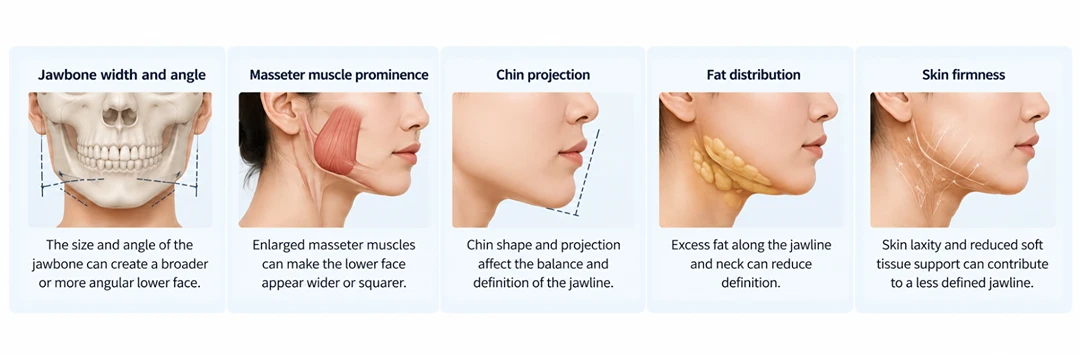
Jaw contouring may help address concerns such as:
- Broad or square jawline — A wider lower face caused by prominent jaw angles or enlarged masseter muscles.
- Prominent jaw angles — Angular bone structure that creates a more pronounced or squared lower facial appearance.
- Facial asymmetry — Differences in jaw shape or contour between the left and right sides of the face.
- Poor jawline definition — A less distinct transition between the jaw and neck due to excess fat, skin laxity or underlying anatomy.
- Disproportionate lower face — A jawline that appears too wide or prominent relative to the cheeks and chin.
Not all concerns require surgical correction. Identifying whether the underlying cause is skeletal, muscular or related to soft tissue helps guide treatment selection.
Who may be suitable for jaw reshaping?
Jaw reshaping may be considered for individuals who wish to improve the shape, symmetry or definition of their lower face. Depending on the underlying anatomy, suitable candidates may include those who:
- Have a broad or square jawline due to prominent jawbone structure or enlarged masseter muscles.
- Notice facial asymmetry caused by differences in jaw shape or muscle prominence.
- Wish to soften prominent jaw angles or achieve a more tapered lower facial contour.
- Have concerns about jawline definition due to excess fat or mild skin laxity.
- Are in good general health and have realistic expectations about what treatment can achieve.
What to expect during jaw reshaping treatment
The jaw reshaping process varies depending on whether surgical or non-surgical treatment is recommended. However, both approaches begin with a detailed assessment of your facial anatomy, concerns and desired outcome.
Consultation and Facial Assessment
During your consultation, your plastic surgeon will assess several factors, including:
- Jawbone structure — The width, angle and overall shape of your lower jaw.
- Chin position — How the chin relates to the jawline and other facial features.
- Masseter muscle size — Whether muscle prominence contributes to lower facial width.
- Skin and soft tissue — The presence of excess fat, skin laxity or reduced tissue support.
- Facial symmetry — Differences between the left and right sides of the lower face.
Photographs and facial measurements may be taken to evaluate your proportions from different angles. For surgical jaw reshaping, additional imaging, such as X-rays or CT scans, may be required to assess the jawbone and surrounding anatomical structures.
During the Procedure
The treatment process depends on the approach selected.
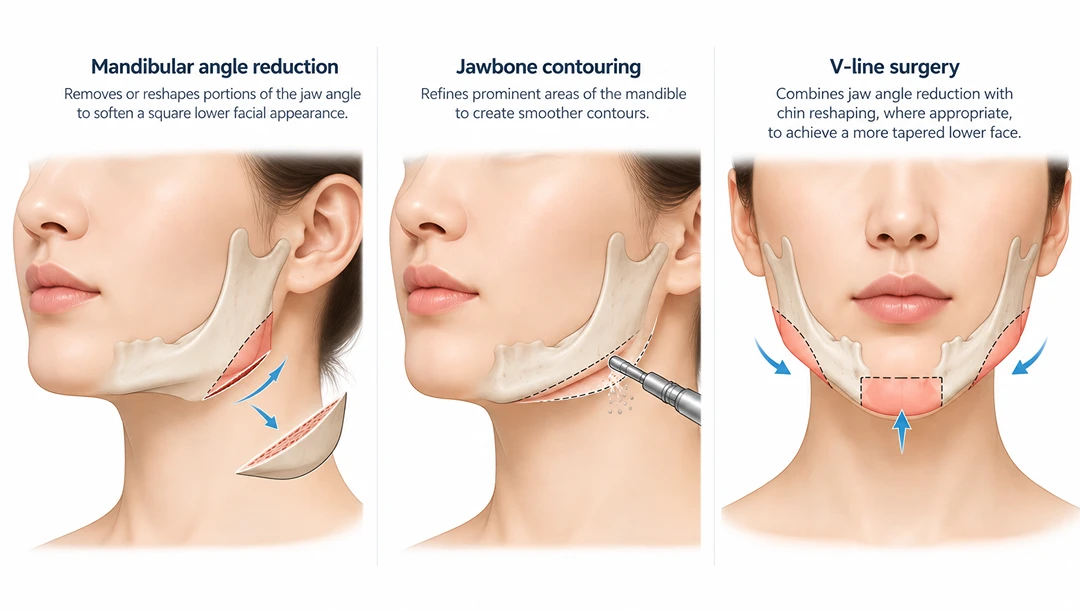
Surgical Jaw Reshaping
When the underlying jawbone contributes to excessive width or angularity, surgery may involve:
- Mandibular angle reduction — Removing or reshaping portions of the jaw angle to soften a square lower facial appearance.
- Jawbone contouring — Refining prominent areas of the mandible to create smoother contours.
- V-line surgery — Combining jaw angle reduction with chin reshaping, where appropriate, to achieve a more tapered lower face.
Surgical jaw contouring is typically performed under general anaesthesia. The surgeon may use incisions inside the mouth to access the jawbone, although the technique depends on the procedure. Careful planning is necessary to protect nearby nerves, preserve jaw function and avoid excessive bone reduction.
Non-Surgical Jaw Contouring
For concerns involving muscle prominence or soft tissue, treatment may include:
- Masseter botulinum toxin injections — Relaxes enlarged jaw muscles, gradually reducing their bulk.
- Chin fillers — Improve chin projection or contour to enhance lower facial proportions.
- Skin-tightening treatments — Using Radiofrequency Assisted Lipolysis, localised pockets of fat accumulation can be addressed along with skin tightening from the heat generated. This can address mild-to-moderate skin laxity and improve jawline definition.
These treatments are generally performed in an outpatient setting, with recovery and results varying according to the procedure.
Recovery after jaw contouring
Recovery after jaw contouring depends on the type of treatment performed. Non-surgical procedures generally involve less downtime, while surgical jaw reshaping requires a longer healing period as the bone and surrounding tissues recover.
Recovery After Surgical Jaw Reshaping
Following surgical jaw contouring, patients can expect swelling, bruising and some discomfort around the lower face. Temporary numbness, tightness or difficulty opening the mouth may also occur.
Recovery generally progresses as follows:
Recovery Period | What to Expect |
First few days | Swelling and discomfort are usually most noticeable. Pain medication, cold compresses and a modified diet may be recommended. |
First 1–2 weeks | Initial swelling and bruising gradually improve. Patients may need to avoid strenuous activities and continue with a soft diet. |
Weeks 3–6 | Most visible swelling continues to subside, and daily activities can gradually resume according to the surgeon’s advice. |
Following months | Residual swelling settles, allowing the refined jawline to become more apparent. Bone and soft tissue healing continue over time. |
Recovery After Non-Surgical Jaw Contouring
Non-surgical jaw contouring generally involves less downtime, with most patients able to resume their daily activities shortly after treatment. Mild swelling, redness, tenderness or bruising may occur, depending on the procedure performed. Recovery is typically quicker than surgical jaw reshaping, although results may develop gradually over several weeks, particularly with treatments such as masseter botulinum toxin injections or skin tightening with energy devices such as RFAL (Radio-frequency Assisted Lipolysis).
What is the cost of jaw reshaping in Singapore?
The cost of jaw reshaping in Singapore depends on whether the procedure is surgical or non-surgical, the extent of correction required and the complexity of treatment.
Several factors can influence the overall cost:
- Type of procedure — Surgical jaw contouring generally costs more than non-surgical treatments due to the complexity involved.
- Extent of correction — More extensive bone reshaping or asymmetry correction may require additional planning and operating time.
- Combination procedures — Combining jaw reshaping with chin contouring or other facial procedures can increase the total cost.
- Anaesthesia and facility fees — Surgical procedures may involve additional charges for anaesthesia, operating theatre use and hospital facilities.
- Post-treatment care — Medication, follow-up consultations and recovery-related expenses may contribute to the overall cost.
A consultation with Dr Pearlie Tan can help determine the most appropriate treatment approach and provide a personalised cost estimate based on your facial anatomy and treatment goals.
Book a consultation
Jaw reshaping is not a one-size-fits-all procedure. Whether your concern involves a broad jawline, prominent jaw angles or facial asymmetry, identifying the underlying cause is essential to choosing an appropriate treatment.
At Pearl Plastic Surgery, Dr Pearlie Tan assesses your facial anatomy, jawbone structure and aesthetic goals to determine whether surgical or non-surgical jaw contouring may be suitable for you.
If you are considering jaw reshaping in Singapore, schedule a consultation with us to discuss your treatment options, expected outcomes and what may be realistically achievable for your facial structure.

Frequently Asked Questions
Can jaw reshaping reduce a square jaw?
Yes, jaw reshaping can help reduce the appearance of a square jaw, depending on its underlying cause. If the jaw appears square due to prominent bone structure, surgical jaw reduction may be considered. If enlarged masseter muscles contribute to the width, botulinum toxin injections may provide a non-surgical alternative.
Will there be visible scars after jaw contouring surgery?
Jaw contouring surgery is commonly performed through incisions inside the mouth, which helps avoid visible external scars. However, the surgical approach depends on the technique used and the extent of correction required. Your plastic surgeon will explain the planned incision sites during your consultation.
What is the best age for jaw reshaping surgery?
Jaw reshaping surgery is generally considered once facial skeletal growth is complete. Suitability depends on factors such as bone development, general health, facial anatomy and treatment goals rather than age alone.
Can jaw contouring cause sagging skin?
Skin laxity can become more noticeable after surgical jaw reduction, particularly when significant bone volume is removed or the skin has limited elasticity. The risk depends on factors such as age, skin quality and the extent of bone reduction. Your surgeon will assess these factors when planning treatment.
Is jaw reshaping surgery safe?
Jaw reshaping surgery carries risks associated with general anaesthesia and bone surgery, including infection, bleeding, nerve injury, facial asymmetry and changes in jaw function. Careful surgical planning and appropriate patient selection help reduce these risks, although complications cannot be completely eliminated.
Can jaw reshaping be reversed?
Surgical jaw reshaping permanently alters the underlying bone structure and generally cannot be reversed to its original form. Non-surgical treatments, such as masseter botulinum toxin injections and certain fillers, provide temporary results, although their effects and reversibility vary.